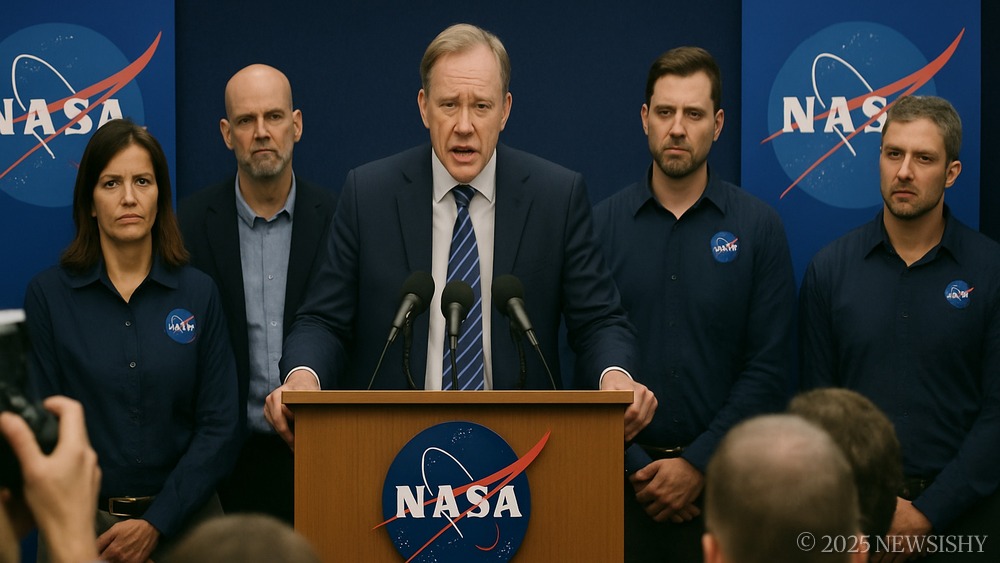
In a shocking revelation that has left the global scientific community in turmoil, NASA has admitted that the Earth is, in fact, flat. The unprecedented announcement came during a hastily arranged press conference where a visibly shaken team of NASA scientists confessed that their long-held belief in a spherical Earth had been entirely mistaken.
Dr. Seth Sialis, an astrophysicist who led the investigation, stood before a room of stunned journalists and began his statement with an uncharacteristically simple message: “We are sorry. We should have done better.”
According to Dr. Sialis, the investigation originally started as an effort to silence what NASA believed to be an increasing wave of misinformation spread by conspiracy theorists on platforms such as YouTube and TikTok. “We set out to prove, once and for all, that the Earth is a globe. We had every intention of using real science to debunk what we considered absolute nonsense,” he explained. “But as we conducted our research, the data kept pointing in a very different direction. The evidence for a spherical Earth simply wasn’t there. And now… we feel really, really stupid.”
The Stunning Discovery
As camera flashes illuminated the room and reporters scrambled to process the bombshell announcement, NASA scientists outlined the critical flaws in the globe model that led to their reassessment.
“Consider the horizon,” Dr. Sialis explained. “No matter how high one ascends—whether on a mountaintop or in an aircraft—it always appears perfectly level. If the Earth were truly a sphere, there would be a noticeable curve. Yet, despite all of our technology, we have never been able to detect this curvature. That alone should have raised serious red flags.”
The panel went on to address one of the most glaring contradictions to the globe theory—water. “Water always finds its level,” Dr. Sialis continued. “The idea that massive oceans curve around a spinning ball is fundamentally flawed. Fluid dynamics do not support such a claim. If the Earth were truly a sphere, we would expect to see measurable convexity across great distances, yet no such curvature has ever been observed.”
Questioning Gravity and Space Imagery
Perhaps most controversially, the NASA team admitted that the entire concept of gravity—the force supposedly keeping everything adhered to a spinning planet—no longer held up to scrutiny. “Gravity is an assumption, not an observable phenomenon,” said one scientist who declined to be named. “The simpler explanation is density and buoyancy. Objects fall because they are denser than the air around them, not because of some invisible force pulling them toward an alleged ‘core.’”
The panel also addressed one of the most commonly cited pieces of evidence for a round Earth—photographs taken from space. “Many will point to images from the Moon landings or the International Space Station,” Dr. Sialis acknowledged, “but we now understand that these images do not constitute proof. NASA itself has admitted that many of its ‘photos’ are actually composites, heavily altered, or even CGI-generated.”
Furthermore, they revealed that images showing a curved Earth were often the result of fisheye lenses distorting the view. “Independent weather balloon footage, taken without such lenses, consistently shows a flat horizon at all altitudes,” Dr. Sialis stated.
What Happens Next?
NASA’s admission has sent shockwaves through the scientific establishment, with physicists, astronomers, and government officials scrambling to contain the fallout. Meanwhile, Flat Earth advocates—long ridiculed as conspiracy theorists—have erupted in celebration, with some demanding formal apologies from those who dismissed their claims.
For now, NASA remains in damage-control mode. “This is undoubtedly the most embarrassing moment in our agency’s history,” Dr. Sialis admitted. “We don’t expect people to trust us ever again. And frankly, we don’t blame them.”
As the press conference concluded, one reporter shouted the question on everyone’s mind: “If the Earth is flat… what else have you been lying about?” Dr. Sialis hesitated for a moment before responding. “You don’t want to know.”